Monday, February 22, 2010

Meet Bonnerichthys!


Just to toot our own horn.

There is a new name for the giant fish formerly known as Protosphyraena gladius. This fish has been known since the 1870s int he Niobrara Chalk, and Cope himself in 1875 had described the pectoral fins of (then) "Portheus" gladius as a "formidable weapon, and could readily be used to split wood in the fossilized condition". We here at the RMDRC do not condone the use of fossil fish fins for wood splitting.

The article covers two specimens, one that we prepared here in 2008, the other that we assisted Mike Everhart in collecting and are still working on.

The work showed that this fish, though related to the cretaceous swordfish analogue Protosphyraena perniciosa, was in fact a planktivorous filter feeder, much like modern whale sharks and manta rays. This type of feeding behavior was not yet reported for animals in the western interior seaway, and is pretty exciting, especially for an animal with a complete lack of sharp pointy teeth.

We are currently working on the first 3d reconstruction made from casts of the specimens in our collection. Keep checking back for progress! Painting at top Copyright Robert Nicholls, used in our paper.

Thursday, February 4, 2010

Daspletosaurus vs. T-rex


One of Pete 3's humerus compared to a cast of Peck's Rex. The other humerus is awiting removal from the main jacket.

Wednesday, February 3, 2010

More Daspletosaurus fun

Pete 3 is rolling along in prep, with 5 jackets finished in the past week (to be fair, 2 of them were 95% done when we shelved the project last May). I'm working through the dorsal ribs and gastralia (belly ribs), because they're quick and easy and usually the last thing anyone wants to work on. The rib head below was finished yesterday, part of the material we had to pull off of the 4-ton jacket early in the prep process. The remainder of the shaft is still on the to-be-prepared shelves, but I hope to get to it very soon. Man, this Daspletosaurus was big.


Friday, January 29, 2010

Pete 3 now published!

For all of you out there keeping tabs on our Daspletosaurus prep projects (which seem to be hitting high gear again), you probably know how much I complain about the matrix and bone quality issues on them. For BCT, it's soft-ish bone locked in a hard sandstone with Ironstone concretion. On the exact opposite end of the spectrum it is Pete 3 with very soft sandy matrix encasing super fragile and shattered bones.

I did a poster presentation on the Pete 3 issue at the first Fossil Preparations and Collections Symposium that Matt Brown helped host in 2008. The paper is now available online with the entire collection of presentations from the meeting.

Congrats Matt on making the volume available, and I hope to see some blog readers at this years meeting in Chicago.

Saturday, January 23, 2010


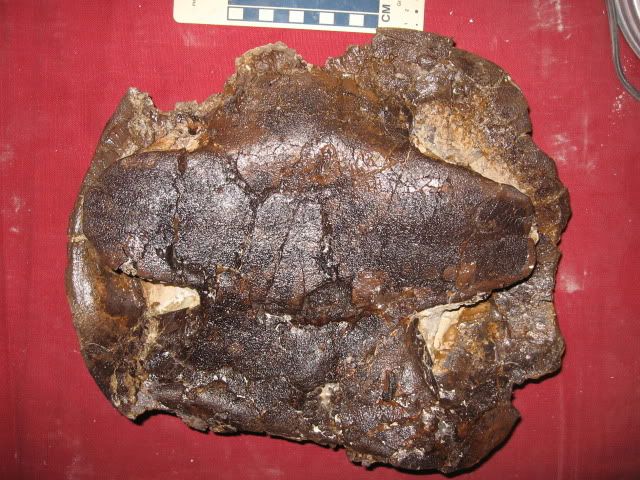
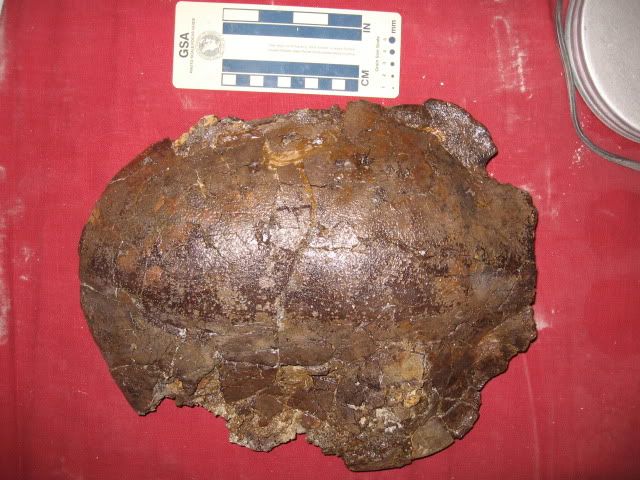
This turtle was recovered in 2006 from the Hell Creek Formation of southwestern North Dakota. Anyone have a guess to it's identity?

Monday, January 18, 2010

Daspletosaurus progress


If you've been following the RMDRC newsletter since our museum opened, you're probably familiar with our BCT Daspletosaurus n. sp. specimen, nicknamed "Sir William". If so, skip ahead a bit.

BCT is a tyrannosaur discovered in 2001 in central Montana. It was originally thought to be in the Hell Creek Formation, making it a small Tyrannosaurus rex. Later, in 2005, it was discovered that the rocks were actually lower Judith River Formation, meaning that it is most likely Daspletosaurus. This specimen is an adult at 16 years of age (as determined by Greg Erickson) but displays some non-traditional Daspletosaurus traits, such as only 13 dentary alveoli (lower jaw tooth sockets), incidentally the same number as normally found in T. rex. Curious.

The excavation was very difficult, and took the summers of 2002 and 2003. The bones were encased in a combination of hard sandstone and ironstone concretions. Preparation was likewise slow.

This cervical vertebra is one of the last bones to be prepared from BCT, starting out as a 40 pound block of hard hard rock. After 30 hours of air scribe and air abrasion work this giant and beautiful bone is nearly done. Good job, Jacob, in getting this specimen ready for display!

Wednesday, December 30, 2009

Last of Leroy for the year


OK, embedding of this Xiphactinus is done, assembly is done, now all that is ahead of us are hours upon hours of detailing. That and figuring out exactly how it's getting upright. That will be an interesting day... I don't think I want to take video of that.

On the bright side not only is the project almost done, but to preserve our sanity Jacob and I have been able to devote one hour at the end of each day to preparing other stuff. Special treat for follower Saurian, Jacob has been preparing a cervical vertebra from our BCT specimen of Daspletosaurus n. sp., out of the lower Judith River Fm. I on the other hand have a special secret non-dinosaur project, that I hope I'll be able to reveal in the first quarter of the new year. It's very exciting, trust me!

Below is a new photo of the progress made in the past week. Exciting, no?