Wednesday, May 26, 2010

Meet Tony II!


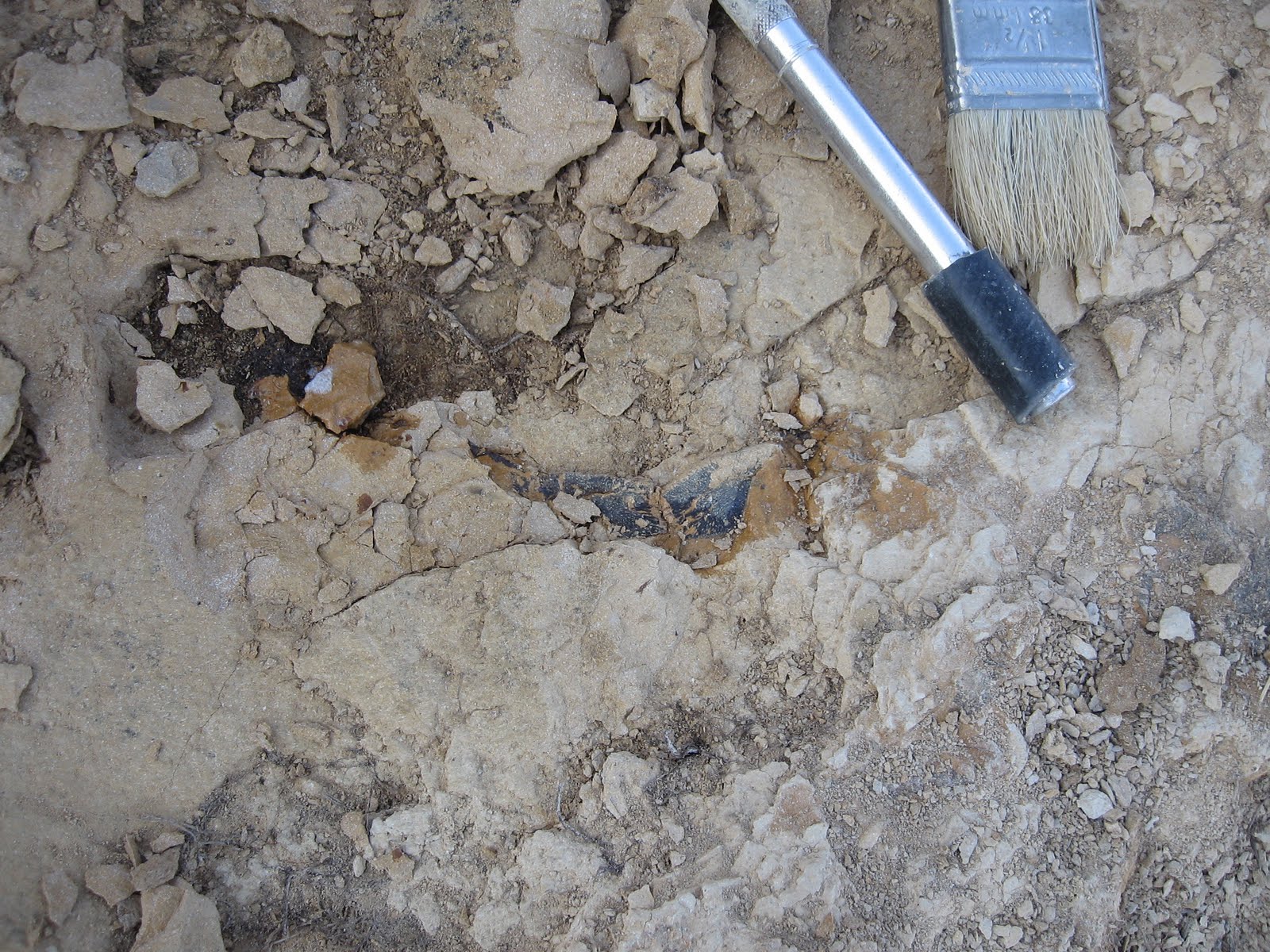
Well, field season started off with a bang this year. The little mosasaur snout I found in late April turned out to be a nearly complete specimen of Clidastes c.f. moorevillensis, which isn't really supposed to be in the chalk. The critter measures 4.8m long (16 feet), and is so well preserved that it retains cartilage in the ear, sternum, sternal ribs and above the scapulas.
Above, Mike Triebold uses a chainsaw with a special blade to separate the block away from the outcrop prior to jacketing. This chalk was the hardest we've ever encounterred in nearly 3 decades of collecting in the Niobrara.


The site as seen from the top of an adjacent bluff. Luckily we could drive up to the site to dropp off air compressors and generators!

Below is the prepared front half of the animal. 45cm (18 inches) of backbone was lost in the mid dorsal section due to erosion years ago. The tail section was taken out in another large jacket. Come see the specimen, now on display in our marine hall at the RMDRC!

Friday, May 14, 2010

RMDRC gets published!


A small project that I've been involved in for a few years, the discovery of the first heteromorph (open coiled) ammonite from the Niobrara Chalk.

Citation:
Everhart, M.J. and Maltese, A. 2010. First report of a heteromorph ammonite, cf. Glyptoxoceras, from the Smoky Hill Chalk (Santonian) of western Kansas, and a brief review of Niobrara cephalopods. Kansas Academy of Science, Transactions 113:(1-2):64-70.

We discovered the specimen while excavating the "Tracie" Tylosaurus nepaeolicus specimen in June 2008. Triebold Paleontology Inc. donated the ammonite to the Sternberg Museum at Fort Hays State University in 2009 after it became clear this was a scientifically important critter.

Email me if you need a PDF copy of the paper.

Tuesday, April 20, 2010

Kansas Field Season Commences

Well we're heading out again for a quickie recon before my trip to Korea. Hopefully it will be more productive then the last trip, which was a lot of uphill and downhill walking and very little in return. We recovered a partial Xiphactinus skull that I found accidentally last spring, and I found another skull and partial skeleton (so far, it's still going into the outcrop) that we'll be puling out later this spring. Above the first Xiphactinus, I also found and recovered a small turtle, probably Ctenochelys, that even had limb material. This next trip will not have a film crew, so things should go pretty quick!

Monday, March 22, 2010

Disassembling a large jacket

As many of you know, we had to remove our big Daspletosaurus, Pete 3, in 75 different jackets. Jacket RMDRC 06-005-72 was done with a pallet method, weighing in at 4 tons. Paper here on the process.

This week we are making a concerted effort to take that enormous jacket apart, in hopes of keeping it stable as well as recovering a large section of real estate smack dab in the center of the lab. Unfortunately, some bones are going to have to be broken or cut to "unjackstraw" them, but will be reassembled later. The jackstrawed nature of the bones (as well as their fragility) is what made us remove the huge block in the first place, so it's not like it's a huge surprise. Still, it is a lot of work.


Wednesday, March 10, 2010

BCT is finished!

BCT, our large Daspletosaurus that was excavated from 2001 to 2003 from a very very very hard sandstone in eastern Montana is now finished with prep. Paleo teach Jacob Jett finished the last dorsal vertebra, that was encased in a big ugly block of ironstone concretion. I'm just happy I didn't have to work on that!

Next up is restoration and molding. Stay tuned!

Monday, February 22, 2010

Meet Bonnerichthys!


Just to toot our own horn.

There is a new name for the giant fish formerly known as Protosphyraena gladius. This fish has been known since the 1870s int he Niobrara Chalk, and Cope himself in 1875 had described the pectoral fins of (then) "Portheus" gladius as a "formidable weapon, and could readily be used to split wood in the fossilized condition". We here at the RMDRC do not condone the use of fossil fish fins for wood splitting.

The article covers two specimens, one that we prepared here in 2008, the other that we assisted Mike Everhart in collecting and are still working on.

The work showed that this fish, though related to the cretaceous swordfish analogue Protosphyraena perniciosa, was in fact a planktivorous filter feeder, much like modern whale sharks and manta rays. This type of feeding behavior was not yet reported for animals in the western interior seaway, and is pretty exciting, especially for an animal with a complete lack of sharp pointy teeth.

We are currently working on the first 3d reconstruction made from casts of the specimens in our collection. Keep checking back for progress! Painting at top Copyright Robert Nicholls, used in our paper.

Thursday, February 4, 2010

Daspletosaurus vs. T-rex


One of Pete 3's humerus compared to a cast of Peck's Rex. The other humerus is awiting removal from the main jacket.