Tuesday, December 17, 2013

Giant Oviraptor Tracks from the Hell Creek

It's been known for years that there are oviraptor-like dinosaurs found in the Hell Creek Formation. We find isolated elements mostly. A pubis here, a claw there. Small snapshots into their world, but they don't answer deeper questions like how big they got, how they moved, where they lived (instead of just where their remains ended up).
Skeleton of the new Hell Creek Ovi

In 1997 Mike Triebold was scouting on private land in Harding County, SD for dinosaurs. He came across a strange looking concretion. It looked a bit like a footprint, but as we know, concretions can take on all kinds of shapes. Looking closer, there was another concretion, in the same shape nearby. Then another and another, all in a line. A small excavation was started into the nearby outcrop, and the line of concretions continued. Though the overburden was getting too deep to chase them futher, it is likely there are even more still at the site. Mike recovered the specimens and made them available for research, which will be published on shortly.

Tracks in situ. The largest are nearly 60cm (2ft) across
Excavation of tracks
The concretions have now been identified as a preserved as the trackway of a giant North American oviraptorid, much larger than the specimens that we have skeletal remains for. The trackway shows how fast the animal was moving and even what kind of muck it was trudging through. We made molds and casts of the best ones, I'm thinking it may be a great addition to our ovi display in the exhibit hall.

Thursday, November 14, 2013

3d scanner and printer up and running

After several years of fighting with technology, our 3d laser scanning program is up and running here at the RMDRC. We're currently scanning original specimens that are in the restoration queue in order to generate mirror image parts for missing bones. We started with simple parts on the Avaceratops including cranial and limb material, and progressed to more complicated things like the dentary and maxilla. Not satisfied with the amount of punishment we dished out on ourselves, we then tried Enchodus bits like the super thin premaxilla and operculum. They all turned out extremely well.

One of our new printers which works surprisingly well
Now that we have more complete sets of replicas to work with, our restoration of these specimens will be not only much more accurate but also faster.

Avaceratops lower jaw, with white 3d prints of actual material

Avaceratops tibia, split in a computer so it could fit in the printer
Next on the docket is some of the cranial material of our Daspletosaurus specimens. Donor parts from other animals will be brought in and scaled to size. Surprisingly easy to do with the software and operators we now have here. If you are out there and need some items scanned, give us a call!

Thursday, October 10, 2013

Atractosteus from the Hell Creek

I feel a bit guilty. I found a gar specimen last year, in a soft sand, and I was afraid to prepare it. I had nightmares of thousands of bony scales floating loose in space. Well this week I finally took the plunge and started work. I've even been able to identify it to genus (I think). Let's start at the beginning.

June, 2012:
Hey look, a fossil! Toes for scale.
While prospecting in far western Harding County, SD for typical latest Cretaceous dinosaur fauna, Jacob and I climb a really high butte to GPS a Triceratops and see if it's on our landowner's property. No luck, it's a few dozen yards too far south. From up high we see a few very small low outcrops on our landowner's side of the fence that probably should be checked out. Jacob heads towards the pond, I trudge up to a sand blowout about 5 feet high at the most.
Scales in the field

The gar was just laying there in the flats. The scales caught my eye first, then I noticed the vertebrae, and the faint outline of a skull just barely coming to the surface.

Finishing the perimeter and consolidating
We treated the specimen like ones we dig up in Kansas: no need to expose any more, just find the perimeter. If you hit bone (or scales) just move on in a wider circle. The sand was so soft that we did all the work with mason's trowels. In about an hour or so, the site was perimetered.

Jacket's done!
I was fearful that no matter how good of a jacket we made, the thing in the loose sand would collapse out of it as we flipped the jacket, so I made the call to saturate the topside of the block with B-72 to harden it at least a bit. The hydrocal jacket was then applied directly to the rock, no separator being used. By lunchtime we had the jacket under control. Back in the lab, it sat under a workbench for over a year.

October 2013:
The specimen, now known as RMDRC 12-008, alternatively "ValDaGar" after my wife (plus it's really fun to shout), is brought out of storage. I figure it would be good to at least get the skull exposed, if it's there, before SVP. It'd suck to show up a second year in a row and tell researchers "no, we still haven't worked on it yet". After removing a few inches of sand (we dug deep JUST IN CASE) I finally hit something hard. Luckily it was bone, not the other side of the plaster jacket.

Here's where to start

Ok, I admit, it doesn't look pretty
Exposing the skull took surprisingly little time. I moved a bit further back to see if there was indeed articulated body. There was indeed. Every one of the hundreds of scales is getting prepared individually. I'll let the photos speak for themselves
Much better

The body slowly gets exposed

Side of face floated off a bit


Tuesday, September 24, 2013

Prepping the Avaceratops

It's long overdue for an update, and since the weather in Montana isn't cooperating with our plans to head up there today and finish our season in the Judith River, it's as good a time as any to show what we've gotten done in the lab.

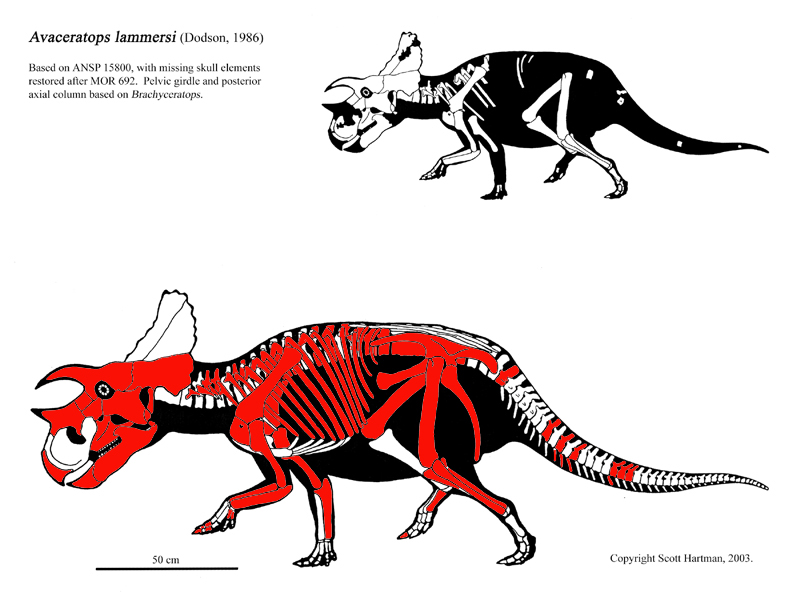
Newer modification to Scott Hartman's illustration: now with no nose horn
Work is slow due to the fact that the bone of this juvenile animal is fairly soft and crumbly when not consolidated, and that many bones are jackstrawed together in larger blocks. Each bone is individually removed from its jacket and checked against the field inventory. When it's a new bone, not exposed in the field excavation, we give it a separate accession number to keep track of it in the lab.

Jacket disassembly with documentation

Typical multi bone jacket before removal
We're primarily using air scribes on the "firm" sanstone matrix, with air abrasion for the detailed work. In some cases, such as the extensive skin impressions over the left hip and rib area, we skip the abrasion in order to preserve the skin as best we can.

Skin texture preserved on the right ilium
Once out of the rock, we restore the cracks and missing bits with epoxy putty in order to get the bones ready for molding. Our current plan, due to the completeness of the skull and skeleton, is to mold everything and do a full skeletal restoration. The animal looks like it will be less than 1.5m tall at the hips - very manageable for a ceratopsian.
Molding jaw parts prior to laser scanning


Wednesday, August 28, 2013

Avaceratops now has skin!


Very large lambeosaur tibia on the east edge of the site

We've been so busy working the Avaceratops site in central Montana that I've hardly had a chance to think of this blog let alone update it. Luckily, that means we've found a lot of stuff, including most of the skeleton of this very rare animal.

Measuring a jacket before putting plaster over it
The site, which started out as a small hand dug pit at the bottom of a wash, ended up as a hole the size of a decent basement. Bobcat excavators, jackhammers and air tools (complete with 2 compressors running)made for a noisy and gritty dig site, but the work paid off.

That's a sizable hole

Using the bobcat to haul out heavy things

Prep is now starting in the lab with the ultimate goal of making a complete restored cast skeleton. We're slowly filling in our bone map, updating it weekly with the bones we're sure we have. Thanks to Scott Hartman for the base image. You can see more of his reconstructions here.
More bones to come as prep continues


Working the final jacket

As mentioned, the Avaceratops has a very faint set of skin impressions with it. Not extraordinarily spectacular, however it is the first time it's ever been found for this kind of dinosaur. I'm excited!
Flipped and getting lightened for transport

Can you see the skin pattern?

Thursday, July 25, 2013

Field season in full swing

Sorry for the lack of updates lately. We've been in South Dakota and Montana working the Hell Creek and Judith River Formations respectively.

Jacob for scale before we open a Triceratops site
South Dakota had seen its fair share of rain, where we got rained out more in two weeks there than in my entire previous decade of Hell Creek digging combined. We pulled a few Triceratops bones and finished evaluating a few sites before moving on north.

Nanotyrannus teeth collected from a single lag deposit
In Montana, our main focus has been opening the Avaceratops dig again and pulling out more of the animal. Lots of bobcat work The back wall of the quarry is nearing 10 feet tall now. Hopefully we're ending the dig soon so we can explore... Enjoy the photos!


Huge fault in the Hell Creek. Jacob somewhere to the left


It's the greenest I've ever seen in July for Montana in the JRF

I cut the steep part of the bobcat road. It's pretty scary to use. 

Duckbill butt I found a few years ago. Finally excavated this year.

After excavation and pedestaling

Part of the Avaceratops braincase

Ava site a few weeks back, before Bobcat work to push the wall back

Tuesday, June 18, 2013

Enchodus rears it's head!

Over the past few weeks, Jacob and I were out doing some scouting and excavation in the lower Niobrara chalk in western Kansas. With the recent drought in the area, not much erosion has happened and so specimens were a bit tough to come by. Though we were blessed with instructions to just record fish localities, secure them, and move on, sometimes the fish are just too good to pass up.

Enchodus palatine fang eroding out
One of our long term goals is to expand our 3 dimensional fish reproductions from Kansas. We've completed 4 so far (Xiphactinus, Ichthyodectes, Saurodon, Pachyrhizodus) and we're working on Megalocoelacanthus as our 5th. Enchodus has always been on our wish list (one of the most common fish in the WIS, and those fangs... people love pointy parts), however the large specimens of Enchodus petrosus are very rare, especially anything resembling a complete skeleton and not just isolated palatine bones with fangs.
RMDRC 13-001 fanf after prep
Jacob struck first with a very large Enchodus fang protruding from the grey chalk between MU 7 and 8 He took down the overburden and exposed a sizable disarticulated skull with pectoral fins and vertebrae. We prepared a good portion of it in the lab and have decided that this specimen is where we will mold the majority of the individual elements from.
RMDRC 13-001 digsite

A few days later I was working an outcrop slightly lower (just above MU 6) and was shocked to find an articulated skull weathering out of some seriously soft chalk. I hoped it was attached to the rest of an Enchodus.
RMDRC 13-005 as found

Originally we were going to "Sternberg" the specimen (pouring plaster directly over the exposed bones to stabilize everything in the jacket) assuming that there was more resent at the site. Unfortunately, sometimes all you get is a head. In this case a giant one (lower jaw 25cm long) indicating an overall length of about 1.25m. This will be the basis for our overall reconstruction.
RMDRC 13-005, bottom side prepared

We're hoping for the prototype to be completed and ready for SVP at the end of October. Fingers crossed.