Wednesday, September 28, 2011

Light at the end of the Triceratops tunnel

We're back from another great Denver Gem and Mineral show. I even got Bob Dietrich to sign my copy of "Boneheads" by Richard Polsky. Dr. Bakker had some good input about javelinas, and we got our Bacculites jaws back from being prepared by Neal Larson.
Captain Jacob on the SS Pointyface

We're now back in our final push to get this giant Triceratops skull built and out of our workspace. We figure less than 3 weeks to go. All assembly is finished, save for installing the missing maxillary teeth. Steel work is also done (I incinerated 3 t-shirts during that process), all that it really left is details details details. Also painting. Today I should hopefully be finished hollowing out the ironstone from the orbits in the last bit of preparation.
A month's worth of work. Also I made the table.

We've got a space picked out in the museum and will let all of our readers know when it goes on display, so you can come visit it in person. Sad thing is, I don't think this Triceratops has a name yet...

Wednesday, September 14, 2011

Triceratops project update # whatever

8 feet long and 5 feet wide, about the same size as my bathroom
Ok the assembly process is almost done! We've assembled almost all of the frill, a process that took me a week and a half and 100 pounds of steel. I only severely burned myself 4 or 5 times, including a big melty blob that rolled down my shoulder and back. Ouch.

7 days of constant custom steel fabrication, and still not yet done.

Now it is time for the tedious texturing of the filler that went into areas where we were missing bone. We're leaving the busted part of the parietal off while we work around it. Also note in the photos the fancy stage that I built in an effort to save our backs while detailing. A bit of epoxy putty, some epoccipitals, and some paint will get us to the finish line, now hopefully around Halloween, if not sooner. It's painstaking work, send beer,

Thursday, August 25, 2011

Poached Again, Dammit

Hey, I recognize that plastic!
This past week Mike and Jacob returned to Kansas to do some field work, and were reminded by the heat and lack of breeze exactly why we don't usually go back till fall. They scouted some outcrops near where we discovered the poached Protosphyraena fin earlier this year. About 1/4 mile south of that site, Jacob spotted a sliver of blue plastic coming out of the outcrop... again.

View from the site
It was haphazardly covered with about 1 foot of loose chalk and had appeared to have been excavated about 2 years ago judging from the size of the plants growing in the talus. As with the last poaching attempt, the site was nearly completely excavated down to the bone layer before it was abandoned/re-covered. I have the distinct feeling these poachers may be headhunters.
Critter just prior to jacketing
After exposing it,the site turned out to be a sorta jumbled Xiphactinus coming out tail first. There may or may not be skull bits present. Our crew made short work of the specimen and took it out in 3 jackets. After that, the thermometer hit 109 degrees before lunch and it was time to get the proverbial hell out of Dodge. I think hunting out there will be better in about a month. Especially with someone out there finding and pre-excavating specimens for us.

Thursday, August 4, 2011

The Coelacanths of Kansas

Most everyone is aware of the story of the "living fossil" fish, the coelacanth. One was caught off the coast of Africa in the 1930s, surprising everyone since they were thought to have gone extinct at the end of the Cretaceous period along with the dinosaurs. Today there is but one genus left, Latimeria. They are strange animals, even for people experienced in working with fish.

Cast of the extant coelacanth Latimeria in the RMDRC
We recovered and prepared 2 specimens of the giant coelacanth Megalocoelacanthus from western Kansas in the past decade. As far as I know they are the only two examples of this big coelacanth ever recovered from the Niobrara chalk. The first specimen was excavated from the lower chalk around MU5 (Coniacian age) is fairly complete, and will be our basis for a 3d reconstruction of the skull and body. The second specimen was a fragmented left lower jaw found in the upper chalk, under MU20, putting it early Campanian in age. We used the coronoid from this specimen in our reconstruction to replace the missing one from the first.

About 20% of the skull material found with our first Megalocoelacanthus
Someone once said "go big or go home". We're taking that to heart as our first reconstruction will consist of a 3d skull on a panel-mounted restoration of the body. We're basing the postcranial skeleton heavily on Latimeria, since we only have a few parts of the pectoral and dorsal fins. Coelacanths don't have ossified vertebrae (or ribs for that matter) meaning skulls and fins are about all you are ever going to find.

RMDRC sculptor Mary working on our prototype
Our specimen is truly going to be a giant, coming in at about 9 feet 4 inches (3m) in length. As far as I can tell this will also be the very first restoration attempt of Megalocoelacanthus. Of course we'll be molding the thing, so hopefully it can be placed in museums worldwide. Ours isn't the largest specimen ever found, but it sure seems it is by far the most complete.

Tuesday, July 26, 2011

Nyctosaurus restoration finished!

Beautifully detailed specimen
We've added another flying critter to our family of casts. This time it's a restoration of a female Nyctosaurus gracilis. This is the smaller of the two flying reptiles found in the Niobrara Chalk of western Kansas, and by far the most rare. Contact me if you're interested in a copy. We're offering a substantial discount off of our introductory price through the end of August.

Top-ish view showing lack of wing claws

Look out for that Pteranodon!

Our restoration ended up with a wingspan of 7 feet. We'll be debuting the crested male specimen in a few weeks, so keep tuned for updates. Also come to the museum to see this specimen now proudly on display in out exhibit hall.

Monday, July 25, 2011

Just a Pretty Picture

Ok, maybe not so pretty because I've volunteered myself to be the RMDRC spokesmodel. Just consider yourself lucky I didn't accessorize with a bikini.

Tuesday, July 19, 2011

Building a Xiphactinus: ground to mount

Initial excavation of RMDRC 10-025 in Lane Co., Kansas
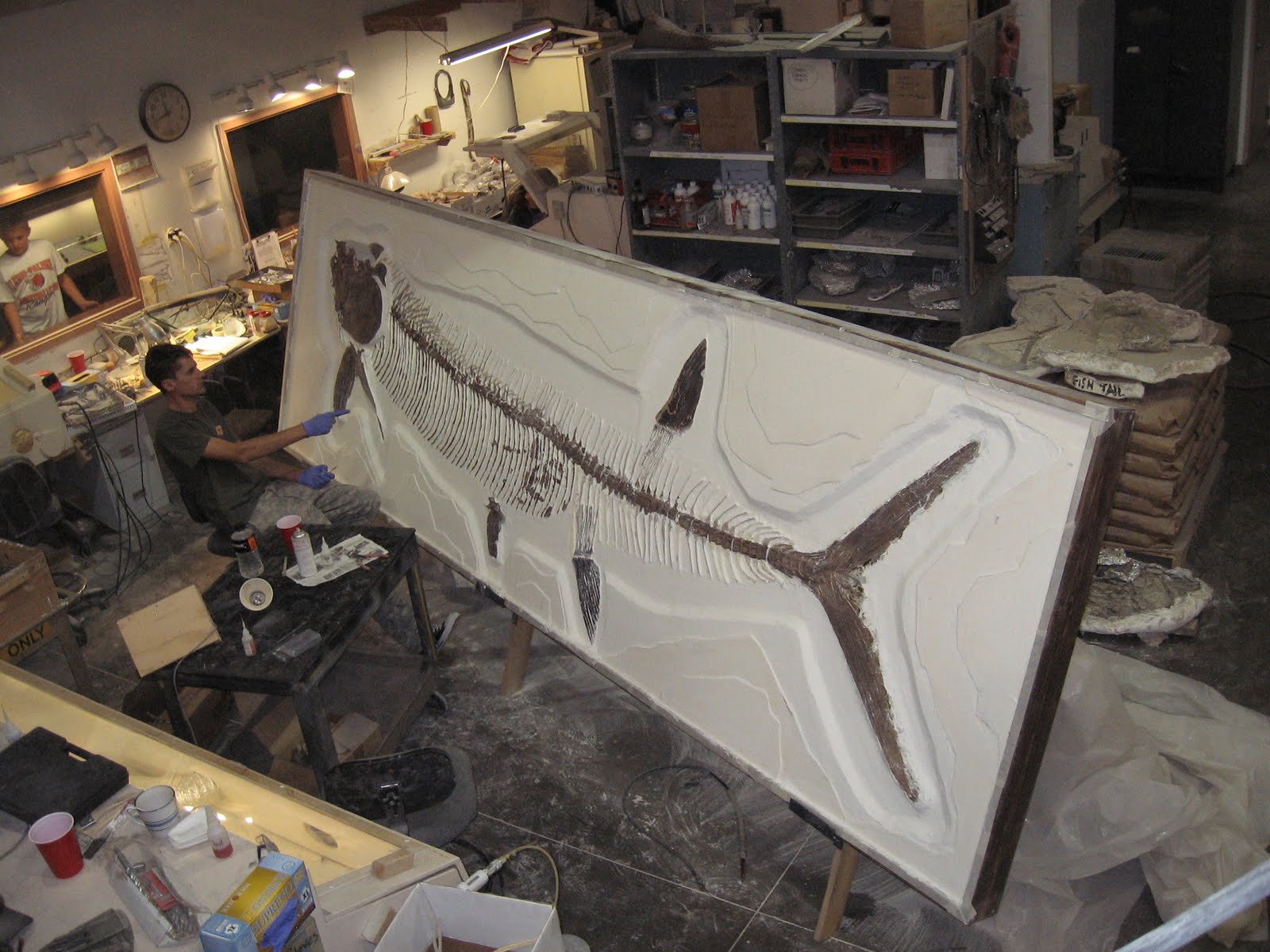
During the 2010 field season, we managed to find and collect part or most of 9 Xiphactinus audax specimens. But what do you do with all of those mainly incomplete fish? In the case with RMDRC 10-025, we decided to prepare and restore the skeleton in a panel mount display. Two factors helped us decide on working with this specimen: It was relatively complete except for the skull, which had weathered out in the float, and it looked to be a pretty small sized fish, possibly only 10 feet long. After all, it was excavated in a fishpile only 7 feet square.

Nice compact pile of fishbone
Since most of the skull was in golf ball sized fragments with eroded edges, we decided to source an already prepared Xiphactinus skull of the same size that was collected on the same ranch a few years prior. Preparation went slowly because of extensive root invasion, resulting in some of the most maddeningly soft fish bone we've ever had the joy of preparing.

Marking paint to denote the cutlines of the 2 jackets
Laying out the critter we found that we grossly underestimated the final size of our animal. From tail tip to procumbent fang it comes in at a whopping 13 feet 4 inches, with the beautiful tail fin 3 1/2 feet tall. Interestingly, there was bits of a Gillicus skull, pectoral fins and vertebral column mixed in with the Xiphactinus, more than likely the remains of its last meal. We included the Gillicus in the mount, because, why not?

Fishie is bigger than curator
No matter, we can make these panel mounts as large as we need. Our last mount was made of steel, plywood and solid Hydrocal, resulting in a 1600 pound monstrosity. This slightly smaller mount is using new techniques, with a finished target weight of below 400 pounds. Fingers crossed, chiropractor on call.
Status as of a few minutes ago. More detailing is needed before paintwork commences
We aim on finishing towards the end of this week. Hopefully. It's amazing how much lab space this thing takes up!