Showing posts with label Protostega. Show all posts

Thursday, November 10, 2016

Reconstructing Chelosphargis: What to do with a pile of bones

We spend a lot of time in Kansas hunting for specimens in the Niobrara chalk. A whole lot of time. Luckily the soft chalk erodes pretty quickly so we also find a whole lot of stuff. Occasionally though, other people also get lucky and we'll happily take the specimen off their hands. In early 2015 this exact scenario played out. You may have seen the result at our display booth at SVP this year in Salt Lake City, overshadowed by our exciting mount of our Daspletosaurus "Pete III"
Curator shadow selfie while digging in Kansas recently

A poorly collected turtle specimen from the chalk was being shown around looking for a buyer, While the collection techniques caused some damage to the fossil, it was plain to see a fairly complete tiny Protostegid was encased in the slabs of yellow rock.

So, this is how we got it. Clearly not how we would collect a specimen.

Most importantly, almost all of the skull was there, which is really nice. We immediately acquired the specimen and prepared the parts. Quickly it became evident we had a older subadult specimen of the relatively rare taxon Chelosphargis advena, an 84 million year old relative of the much larger Protostega and Archelon.
The parts after prep

Skull partway through prep

As you can see, most of the animal was there, in fact it's one of the most complete Chelosphargis specimens ever discovered. But what do you do with a pile of bones once they're all prepared? We're one of the few places with the knowledge, experience and capability to do a complete cast restoration without damaging the original bones. The first step was to mold everything as-is, so we can have parts (sometimes even multiples) to work with.
Cast skull copies getting cut and shaped to take out distortion

Distortion is taken out of the plastic and missing parts are either fabricated from similar ones from this animal, scanned in and resized from other specimens, or in rare cases done the old way with sculpting from reference material.
Carapace getting parts added and completed

The restored parts are then molded again in units so that we can make our final copy and offer it to museums and the general public as a highly detailed cast skeletal mount, perfect for display anywhere. The entire project only takes a few weeks, but the result is pretty phenomenal!

Final product!


Thursday, January 24, 2013

The Little Protostega is Restored!

A final follow-up on the project that I had mentioned in the last update. The project is "finished" for now, all molding is complete and the first two prototypes have been assembles and packed.

Cast bones and skull restoration before assembly
We molded hundreds of individual bones for this project. Those cast parts were restored, put into subassemblies, then remolded to produce the final cast. The cast preserves all the pathologic and taphonomic detail, including what appears to be puncture wounds from predation by one of the many mosasaurs in the Niobrara. I blame it on Tylosaurus.

Prototype #2 flying by the green screen

Prototype #1

Prototype #1 with curator for scale

Amazingly, the whole animal now goes together from a trimmed cast to a final project in less than a week. The first specimen was given to the Sternberg Museum at Fort Hays State University to accompany the original specimen now safely in their collections. The second cast will be on display beginning next week at the Tucson gem and mineral show, at the 22nd street show. Come by and check it out!

Friday, December 21, 2012

Restoring a Protostega

Back in October of 2011, the lovable TPI field crew was brought out to a ranch in western Kansas (very near the site of Sternberg's famous "fish within a fish" specimen) to help with the recovery of giant sea turtle. This turtle skeleton will be reposited in the Sternberg Museum of Natural History at Fort Hays State University. The term giant is used loosely here, since the actual turtle was only about a meter in shell length, nowhere near the car-sized members of its genus that would later cruise the oceans. Field photos shamelessly borrowed from Mike Everhart's wonderful Oceans of Kansas website.

Making the hole bigger with power tools. Also shovels.
The turtle site was located fairly low stratigraphically, and was entombed in a fairly hard grey chalk. Our first order of business was to identify the bone layer and then break out the power tools to remove the overburden from a wide area. I'll say it again, that cute little green jackhammer is a backsaver!

Mike Everhart and I jacketing the slab, with the finger hair saving nitrile gloves
Once down to the bone level we perimitered the specimen, cut around with the chainsaw, and jacketed the whole slab.

Perimitering in the quarry
Exposing more of the bones
That was the easy part! Back in the lab we began by using air abrasion and pneumatic scribes to remove the matrix from the fossil, first the individual bones that were collected before TPI arrived.

Individual bone before prep in the lab...
...and after air abrasion, scribe and glue work
A few interesting surprises popped up once I started removing the chalk. Abrasions on the ventral side of the plastron seem to indicate this turtle pulled itself up some distant beach, possibly suggesting it was a female getting to dry land to lay its eggs, though some modern male sea turtles also come out of the water occasionally. The carapace and especially plastron were covered by what look a heck of a lot like puncture wounds, all unhealed. The front flippers were totally lacking any parts below the elbow, in fact one humerus was bitten completely in half. It sure looks like the turtle was a partial meal for a mosasaur like Tylosaurus before it finally sank to the sea bottom.

Abrasion and puncture marks on the plastron
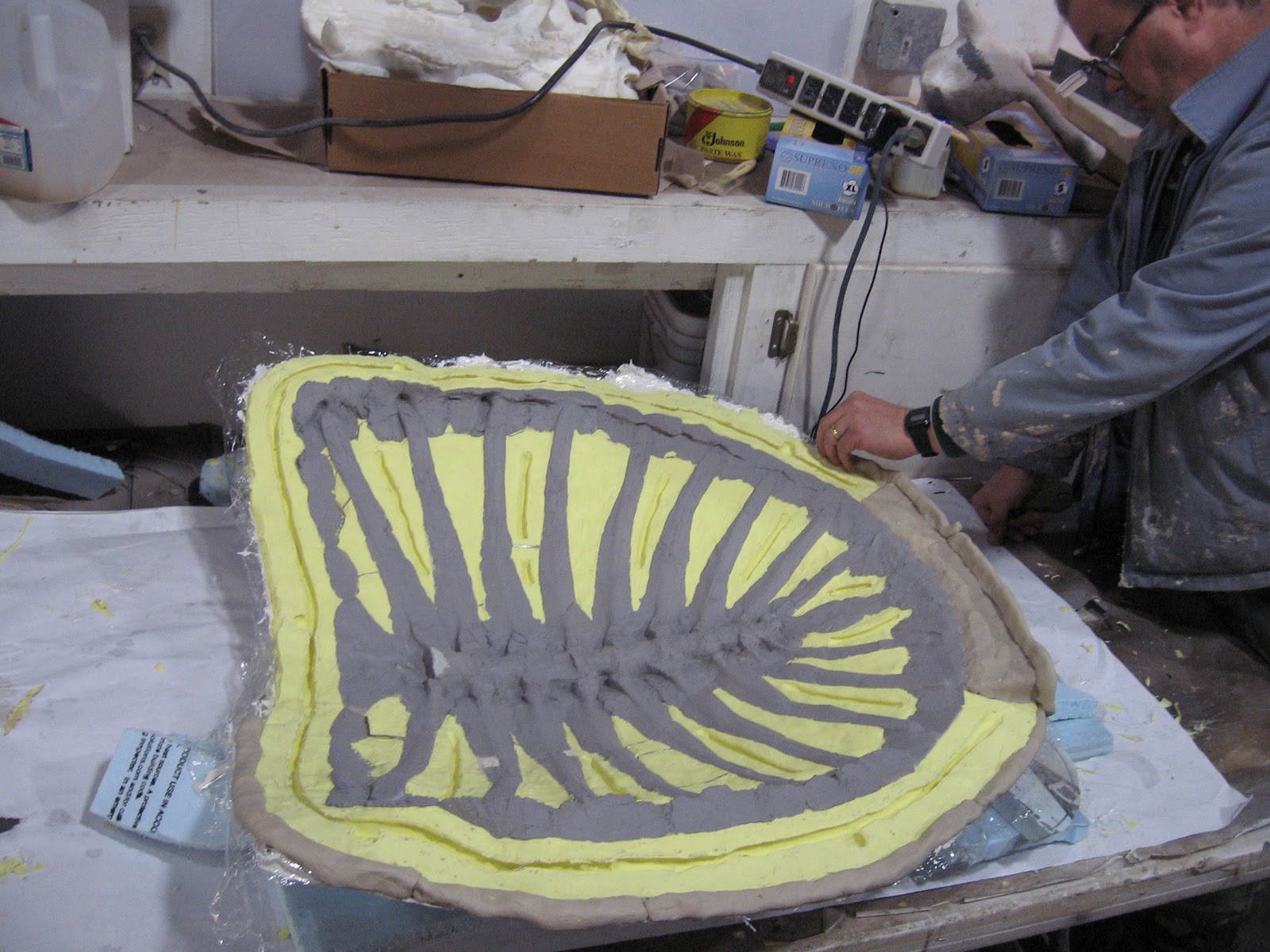
Once the bones were prepared they were all molded individually (when possible). The casts were then manipulated into larger assemblies, where we filled in missing parts and took out some crushing distortion. These assemblies are then used to make production molds for cast copies.

Carapace subassembly in a thixotropic mold
Original bone pile being molded for parts. 
We should have the project done in the next few weeks, just in time to display at the Tucson Gem and Mineral Show this January. Stop on by to check it out!