Wednesday, February 27, 2013

Our own "Project Daspletosaurus"

There has been a fair bit of blog hype recently regarding Dave Hone's fundraising project to study cannibalism in tyrannosaurs. BTW if you feel like kicking in a few bucks, you can do so here. In short, they've observed tyrannosaurs in Alberta that seem to have been eaten by other tyrannosaurs. Neat.

Special thanks to Henry Mendoza for helping sort this drawer of teeth
It got me thinking: "Gee this sounds really familiar, where have I seen this before? Oh right, in these drawers right behind my desk!".  TPI fieldcrews recovered an 11m (35 foot) long Daspletosaurus specimen in 2003 from the lower Judith River Formation of Petroleum Co., Montana. This specimen, known as BCT or "Sir William" was originally thought to be a juvenile Tyrannosaurus rex based off of it's surprisingly low dental tooth count (only 13, Daspletosaurus should have 18-ish) and because of a field stratigraphic error (the rock unit was marked as Hell Creek Fm on some older geologic maps).
Small through large shed teeth from the site

The specimen was recovered in a very hard sandstone and much of it was encased in ironstone concretions. Preparation was difficulty but something stood out: The huge number of shed tyrannosaur teeth mixed in with the main specimen. A whopping 52 teeth from various sized tyrannosaurs shed at this site, in addition to several other rooted teeth that are definitely from BCT.
An example of the big teeth from BCT

So what does this mean? Well, it's another data point that goes a way to confirm the hypothesis, plus we can show that it happened in other geographic areas and with possibly different species of Daspletosaurus (I'm confident that BCT is NOT Daspletosaurus torosus). Plus, in the end, tyrannosaur teeth are just neat.

Thursday, January 24, 2013

The Little Protostega is Restored!

A final follow-up on the project that I had mentioned in the last update. The project is "finished" for now, all molding is complete and the first two prototypes have been assembles and packed.

Cast bones and skull restoration before assembly
We molded hundreds of individual bones for this project. Those cast parts were restored, put into subassemblies, then remolded to produce the final cast. The cast preserves all the pathologic and taphonomic detail, including what appears to be puncture wounds from predation by one of the many mosasaurs in the Niobrara. I blame it on Tylosaurus.

Prototype #2 flying by the green screen

Prototype #1

Prototype #1 with curator for scale

Amazingly, the whole animal now goes together from a trimmed cast to a final project in less than a week. The first specimen was given to the Sternberg Museum at Fort Hays State University to accompany the original specimen now safely in their collections. The second cast will be on display beginning next week at the Tucson gem and mineral show, at the 22nd street show. Come by and check it out!

Friday, December 21, 2012

Restoring a Protostega

Back in October of 2011, the lovable TPI field crew was brought out to a ranch in western Kansas (very near the site of Sternberg's famous "fish within a fish" specimen) to help with the recovery of giant sea turtle. This turtle skeleton will be reposited in the Sternberg Museum of Natural History at Fort Hays State University. The term giant is used loosely here, since the actual turtle was only about a meter in shell length, nowhere near the car-sized members of its genus that would later cruise the oceans. Field photos shamelessly borrowed from Mike Everhart's wonderful Oceans of Kansas website.

Making the hole bigger with power tools. Also shovels.
The turtle site was located fairly low stratigraphically, and was entombed in a fairly hard grey chalk. Our first order of business was to identify the bone layer and then break out the power tools to remove the overburden from a wide area. I'll say it again, that cute little green jackhammer is a backsaver!

Mike Everhart and I jacketing the slab, with the finger hair saving nitrile gloves
Once down to the bone level we perimitered the specimen, cut around with the chainsaw, and jacketed the whole slab.

Perimitering in the quarry
Exposing more of the bones
That was the easy part! Back in the lab we began by using air abrasion and pneumatic scribes to remove the matrix from the fossil, first the individual bones that were collected before TPI arrived.

Individual bone before prep in the lab...
...and after air abrasion, scribe and glue work
A few interesting surprises popped up once I started removing the chalk. Abrasions on the ventral side of the plastron seem to indicate this turtle pulled itself up some distant beach, possibly suggesting it was a female getting to dry land to lay its eggs, though some modern male sea turtles also come out of the water occasionally. The carapace and especially plastron were covered by what look a heck of a lot like puncture wounds, all unhealed. The front flippers were totally lacking any parts below the elbow, in fact one humerus was bitten completely in half. It sure looks like the turtle was a partial meal for a mosasaur like Tylosaurus before it finally sank to the sea bottom.

Abrasion and puncture marks on the plastron
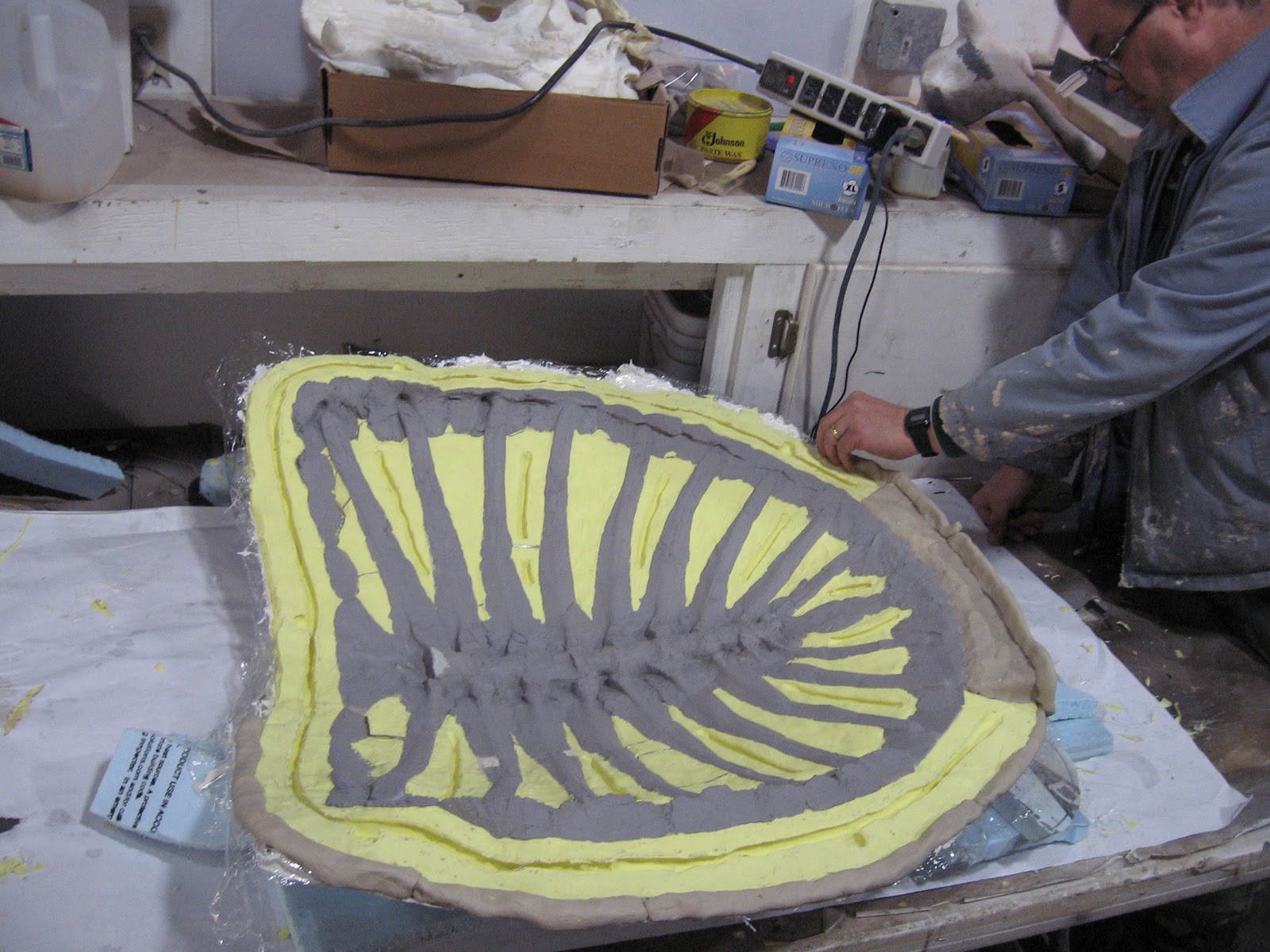
Once the bones were prepared they were all molded individually (when possible). The casts were then manipulated into larger assemblies, where we filled in missing parts and took out some crushing distortion. These assemblies are then used to make production molds for cast copies.

Carapace subassembly in a thixotropic mold
Original bone pile being molded for parts. 
We should have the project done in the next few weeks, just in time to display at the Tucson Gem and Mineral Show this January. Stop on by to check it out!


Wednesday, October 31, 2012

Still prepping the Avaceratops

Though I had a good time attending the SVP meeting in Raleigh, NC this month, it put me a little behinf on prep work. Jacob was able to join the preparation frenzy and between the two of us we've gotten a lot done.

Nasals, showing strange asymmetrical suture
Getting the individual bones prepped out of their jackets is giving us some valuable insights. Though the bones are well preserved, each one is getting its own custom made Hydrocal support cradle to keep them from getting damaged during storage.

The deep and short left dentary, with all teeth
We've uncovered the brow horns now, prepped out the left lower jaw, and finished the nasals. If you're in town you should consider stopping by to get an up-close look at the material. It's some strange stuff!


Strange centrosaurine brow horn, resting in its cradle


Thursday, October 4, 2012

Avaceratops Prep Update

We're on to the big jacket!
Current map of confirmed bones. Base image courtesy Scott Hartmann
Thanks to Scott Hartmann and Skeletaldrawing.com for permission to use his image of Avaceratops' skull.


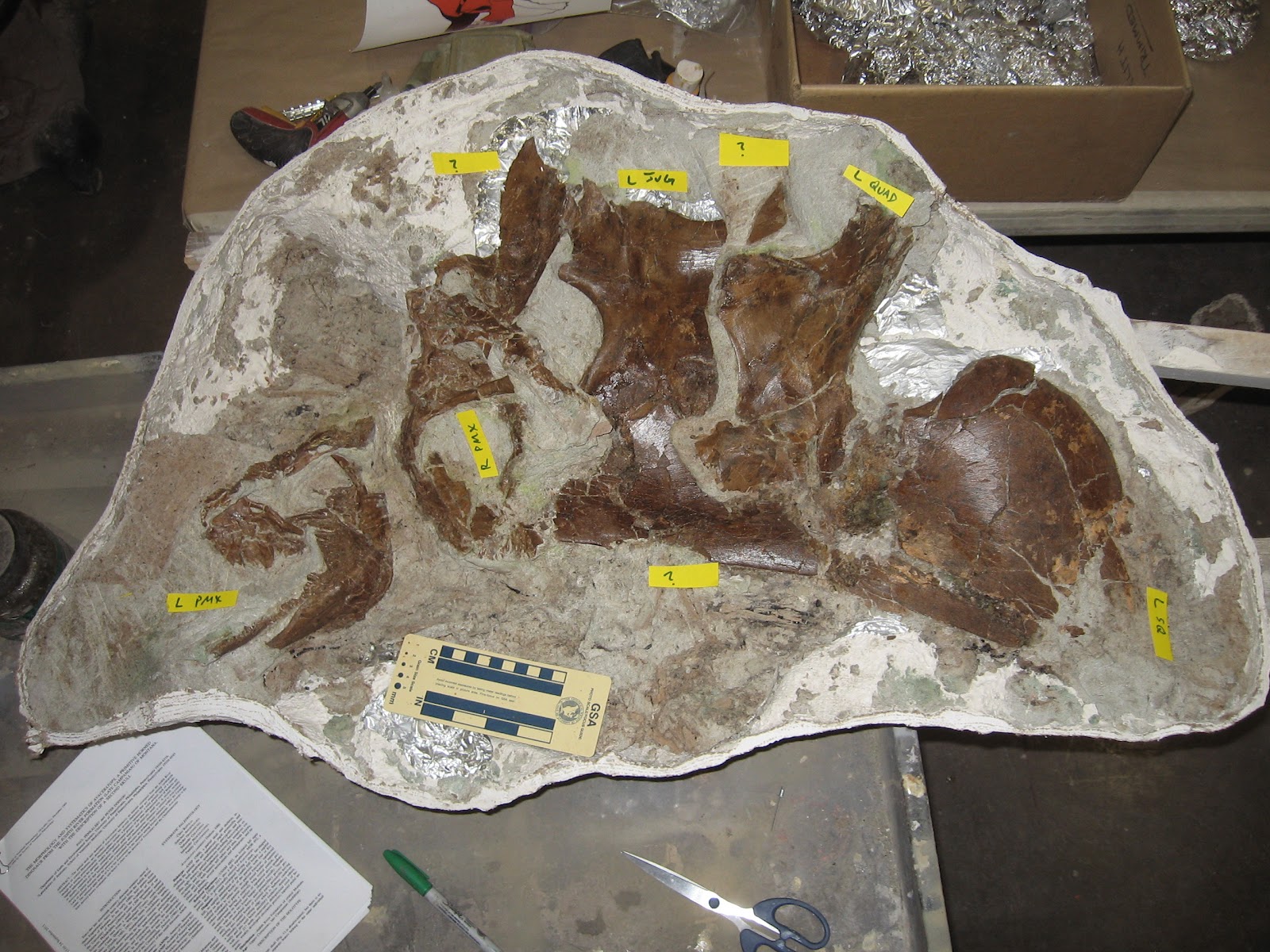
The big jacket, still in preparation
I haven't had an opportunity to expose everything in here yet (there are both postorbital horns hiding deep in this jacket) and I have removed 4 epoccipitals and an epijugal from the mass already, but here it is! Shown in all of its partially prepared glory you see both premaxillae, as well as one each squamosal, jugal, and quadrate. I also have 3 mystery bones comprising a possible parietal or exoccipital (wingy-thing part of the braincase), a possible palatine and another super thin feathery plate.

The next step is to repair my air abrasion unit, cut down the jacket a little bit, and then look for those horns. I'm avoiding removing anything else since everything is so jackstrawed. Combine that with some surprisingly thin and fragile bones, and we could end up with a real mess on our hands.
Bones piled on other bones


Fragile and strangely shaped bones, these take a long time to prepare, only 25-30% done

Wednesday, September 26, 2012

More with Avaceratops

We just got back from the final dig of the 2012 season in the Avaceratops quarry. The weather was outstanding with sun, highs in the 80s and lows near 40. Getting a little chilly in my tent, but nothing uncomfortable.

A few of the epoccipitals. Not very big or pointy.
When we decided to take a jackhammer to the overburden we had only recovered some postcranial elements and one part of the frill, the right squamosal. Many hours later we had blasted out several tons of rock from above our bone layer, and were able to get digging.

The smallest group jacket, with at least 4 bones
To our surprise, nearly all of the bones found in this expansion of the quarry were disarticulated parts of the skull, including some parts that had never been seen before in this genus. We recovered (so far) 8 epoccipitals, the predentary, and a complete jugal (all new), plus both postorbital horns, a left dentary, nasals, maxillae, the other squamosal, and both splenials. There are even more bones in the blocks that we couldn't get a good look at yet, so completeness should further increase.


left Nasal, very well preserved

inside of right maxilla, with a few teeth still in place
I am interpreting the site as a logjam along the southern edge of the quarry, made of (now) carbonized conifer trunks and surprisingly the limb of a very large hadrosaur, the femur measuring a whopping 1.25m long. Check back for more photos as prep continues, and stop by the lab for a look if you are in Woodland Park!

Thursday, September 6, 2012

Digging Avaceratops

It seems just a week ago I was in the badlands of central Montana picking at bones in concrete-hard sandstones of the Judith River Formation. The locality we worked at the end of our trip is known for a nice productive channel lag deposit that gives up claws, teeth, and moderately sized dinosaur bones. Occasionally there are more than a few bones in one spot. We happened upon one of these spots in the lag and discovered a partial skeleton eroding out of the bottom of the exposure. Already a good find in the difficult to scout JRF.

The author, picking away at hard rock

The beginning of opening the quarry


The bones turned out to be from a single Avaceratops, one of the rarest horned dinosaurs in the Judith River Formation. We recovered what bones we could from the hard rock using hand tools, and plan on returning to the site at the end of the month with heavier equipment to get down to the bone layer. So far we've recovered parts of the skull and skeleton yet surprisingly no vertebrae. Hopefully much more of this animal is locked safely in deeper rock.
The right squamosal
The same bone, showing the 3 characteristic bumps
This is a fairly small juvenile specimen, probably only 12 feet (4m) or so in total length. Two of the elements that we recovered tell us this dinosaur is Avaceratops: The squamosal (part of the bony frill) has a series of distinctive bumps on its lateral surface that only happens in Avaceratops. The second bit is a tiny ungual (hoof) of the 4th finger, which is lacking on all other North American ceratopsians.
Toes!

Scapula and coracoid in preparation

Check back with us and see how the excavation goes. We will be bringing in our trusty electric jackhammer and air tools to open up the quarry. We should know more about what is present beginning in October.