
Wednesday, November 25, 2009
Fossil of the week: revived!


Monday, November 23, 2009
Pentanogmius now on display!

Painting of Pentanogmius evolutus adapted from an original work (Plate 30) by Deb Bennett (1983) as published in Kansas Geology, Rex Buchanan (ed.), University of Kansas Press, 1983. Image from http://www.oceansofkansas.com
Tuesday, October 27, 2009
Another rare fish
The Niobrara sea was home to more than just Xiphactinus and sharks. There are dozens of other species of fish, some known very well, others from scrappy remains.

One of the rarest is the fish formerly known as Bananogmius, now Pentanogmius. The name change is sad, really, because I quite enjoy saying "Bananogmius", although not quite as much as I love getting other people to try saying it. It was a large fish with no big teeth, yet a large sail fin running the length of the animal. It had only tiny pectoral and pelvic fins.

The RMDRC has a new articulated specimen (photo above) recovered this year off of private land. The skull is to the left, with the sail fin taking most of the upper half of the large jacket. This one is much larger (over 5 feet long), more complete, and better preserved than the new Denver specimen. It has been "show prepped" to a plaque stage, and will be molded as is. This will get the fish ready for 3d reconstruction using casts of the original bones.
Tuesday, October 20, 2009
Preparing Fish
 Above is the skull of the fish, nicknamed "Leroy". It is currently partially prepared and has been on display in our marine hall since the museum opened over 5 years ago. The body was collected sometime in the mid 1990s. Below you can see Jacob Jett preparing one of the many jacketed slabs of bone and chalk. Trust me, that's really his hand.
I'll continue to update as we proceed, however progress is slow due to how delicate fish bones are, even on these giant predators. Stop by and watch us work in the lab, we will be at this for a while!
Wednesday, October 7, 2009
New Turtle Display Almost Done!
I just wanted everyone to know our new surrogate marine hall is about finished and ready to open, hopefully for this (cold) weekend. We've got quite a turtle-heavy display, featuring skeletons of Archelon, Protostega, Toxochelys, Prionochelys and the shell of Bothremys. Also on display is a mosasaur-bitten Toxochelys shell, RMDRC 08-003 "Kraigums" that I discovered last spring, as well as the only real bones of Megalocoelacanthus dobiei on public display anywhere, the youngest fossil coelacanth found. There are also many more marine touch stations too. Please stop by and let us know what you think!
Thursday, September 17, 2009

Holly is done!
The Pteranodon sternbergi specimen (RMDRC 09-007) I discovered this spring was about 70% complete. The restored elements (mostly parts of the left wing and the lower jaw) are casts of CMNFV 41358, AKA "The Triebold Specimen". It is embedded in an artificial matrix simply because squashed flat bones are not useful for 3d specimen mounts. I am so happy this project is finally finished.
Wednesday, September 9, 2009
Disassembling Joyce
Well, we've finally made time.


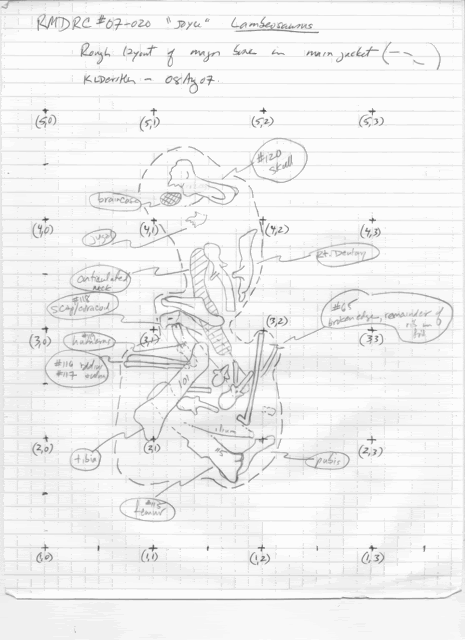
Our Lambeosaurus, Joyce (RMDRC 07-020) is being prepared, partly because the dang main jacket (map above) is taking up way too much space in the prep area of the lab. The problem is that the bones are very difficult to separate. They are jackstrawed together, brittle, and now that all of the water has evaporated out of the jacket, the matrix is much harder.
The site with Kraig and Jacob while exposed for NBC camera crew.
Below is the main block before jacketing. Getting this apart is our newest challenge.
Subscribe to:
Posts (Atom)