Friday, July 20, 2012

Back to the Hell Creek

We're headed back out to excavate a few of the Triceratops sites that we discovered during our last expedition. We didn't waste any time in the lab though, and did a little bit of work on some of the specimens we brought back from or first trip.

Jacob's femur dig site
Jacob discovered a Triceratops femur in a channel lag deposit, directly downwind of a recently deceased cow carcass. It's now being fully prepared (and as it turns out, is only a partial specimen) as a touch bone for a museum opening soon.


Lots of bone chunks on either end, but the main portion is nice


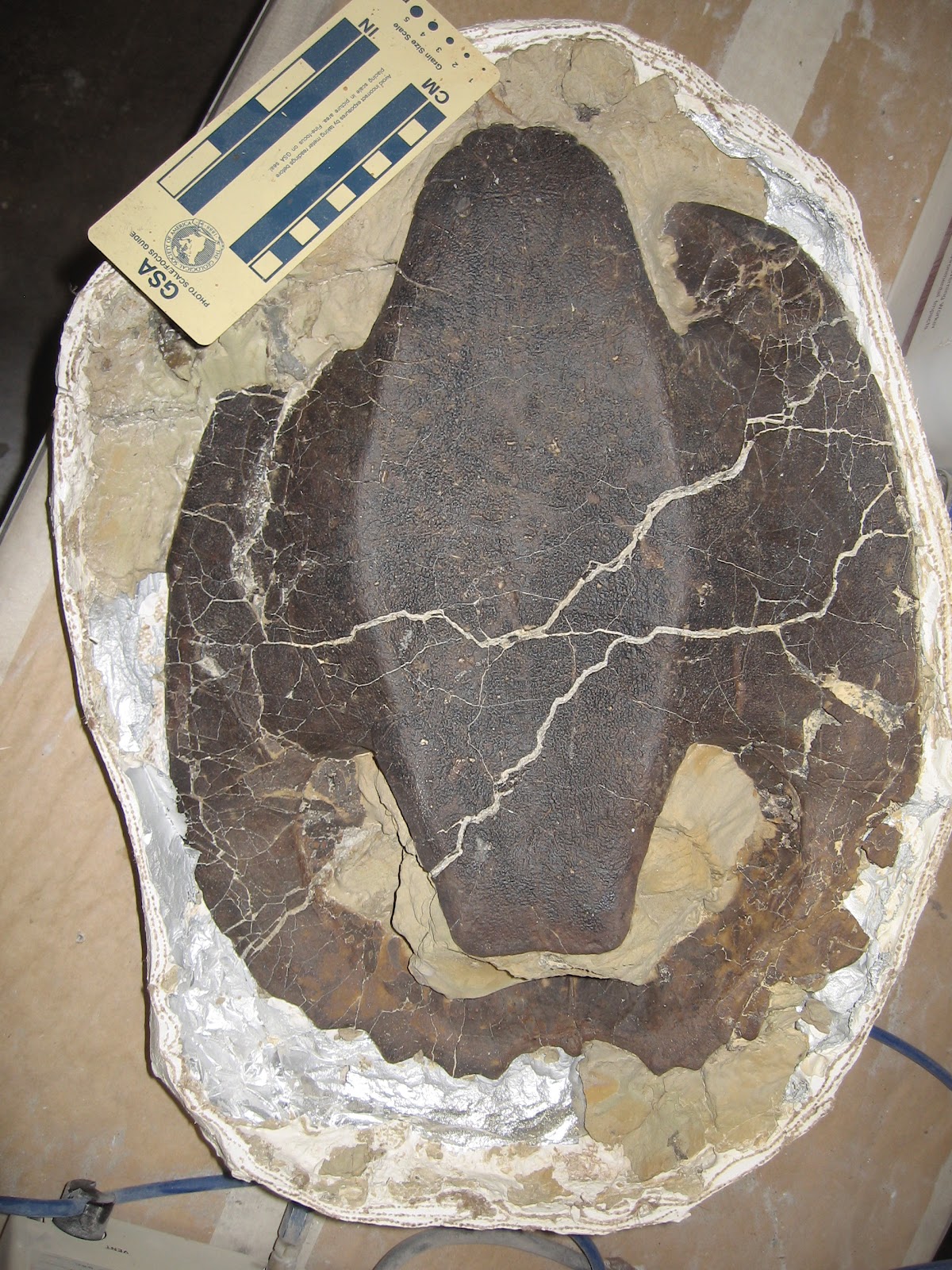
The turtle that I found the first day of the trip has now been identified as Stygiochelys estesi, with a distinctive scallop on the rear end of the carapace.
That's a nice turtle


On the last day of the last trip I discovered the left brow horn and a few other bones of a large Triceratops prorsus.Preliminary preparation of the horn revealed two large and mostly parallel gouges near the distal end. These grooves have bone surface on the bottom and could be interpreted as healed bite marks from an attacking Tyrannosaurus rex. They definitely are not due to crushing or postmortem damage. Exciting stuff!

Triceratops horn site
The show-prepped horn


Grooves outlined for clarity, they do not photograph well

I will update our progress again when we get back from our next trip. Hopefully we will be low on plaster and packed to the gills with fossils!



Thursday, July 5, 2012

Post wildfire fieldwork update

First the good news: Ute pass is now open and so is the museum. Please stop by and visit!

The bad news: The fire was pretty bad. 18,000 acres burned and 350 homes lost, along with 2 deaths. The fire impacted me personally by coming down the mountain and burning within just a few blocks of my home. I was certain for a while that the house was lost but the firefighters saved it in the end. I'm just back from a week evacuated out of the state.

I'll need some help identifying this turtle once it is prepared

Previous to that, however, Jacob and I (and for a little while Mike too) were in South Dakota scouting for new dinosaur skeletons on a 2-week trip. We left most of the material in the ground for now, however we will probably recover many of the 7 dinosaurs that we located at a later date. A smattering of photos below for your enjoyment!
Big old pile of Triceratops bones

Jacob working on a Triceratops on top of a butte

Articulated scales on a mostly articulated gar


Triceratops site discovered on our last day. Jacket is one brow horn.

Friday, June 1, 2012

Helping with museum renovations

I'm a little late to the party, but I wanted to share this link: http://uwgeomuseumrenovations.blogspot.com/2012/05/updates-on-renovations-happening-at-uw.html

A few years back, a crew from TPI took down the Apatosaurus skeleton from the University of Wyoming Geological Museum, reprepared and stabilized the bones, then remounted the skeleton in a more modern (non tail-dragging) pose. Recently the museum has been slated for renovations/asbestos abatement so I was sent up to help Dr. Kelli Trujillo and Bill Turner remove the tail (and a Pteranodon cast, and also an Allosaurus, at least in part) from display so work on the museum could commence.

The tail will be back on display later this year, just in case anyone is concerned. It should be viewed as a minor miracle that I actually made it that far up on a scissor lift. I don't do heights well. You can see a complete cast of this Apatosaurus on display at the RMDRC.

Friday, May 25, 2012

Come on down!

We've finished installing new specimens in the RMDRC's display hall just in time for the holiday weekend. Come by and see the new Appalaciosaurus skeleton, the dromaeosaurus, or maybe even the orca or dugong!

The long-armed tyrannosaur

Monday, May 21, 2012

Packing for scouting

I get a lot of questions about what I bring out with me when I do fieldwork (which hopefully will be starting in a week). It's hard to tell people precisely, so I just decided to get my pack ready for a typical day of scouting in the Kansas chalk.

This is all the equipment I haul around in my pack. It weighs in at 15 pounds, without fossils. I also don't count any of the other gear I am wearing or carrying (such as our "walking shovels").  The Swedish Fish are for luck, the Sour Patch Kids are just tasty. The only thing I forgot to put in the photo is also one of the most important: a pre-flattened roll of toilet paper (flat so yo don't have to chase it downhill with your pants around your ankles when bearcaving). Nobody wants to see that.

Monday, April 23, 2012

A little photographic update: Xiphactinus Mildred

Jacob and Lisa keep plugging along on the gigantic mount of the huge 18 1/2 foot long Xiphactinus audax "Mildred". Basic assembly except for the fins are now finished, hopefully soon we will be able to rotate the mount to its upright position, working on a 5 foot high table is not exactly fun.

Tuesday, April 3, 2012

Infected tails do it better

Sometimes you work on a fossil and just think "oooh, that had to hurt". This tail from a pretty large Clidastes from the upper Niobrara chalk is fairly boring when viewed from afar. Up close though something just doesn't look right.

Yep, pretty boring
Of the 45 bones, 23 are pathological, with 17 of them fused at the centrum in 5 separate masses. All of these bones lack transverse processes, so they come from the lower lobe of Clidastes' bifurcated tail fin: a bit of dangling flesh that might make for a tasty morsel for a predator.
I think this mass used to be 8 separate vertebrae, based on the number of chevrons

The bones, though mostly healed, show bone growth consistent with a long infection. As the tail was the primary means of locomotion/propulsion for mosasaurs, this injury must have been very painful for a very long time for this mosasaur.
3 verts become one

Fused verts, and centra with vertical scars